Writing with AI Without Losing Your Voice: A Practical Workflow for Responsible and ETHICAL AI-Assisted Blogging
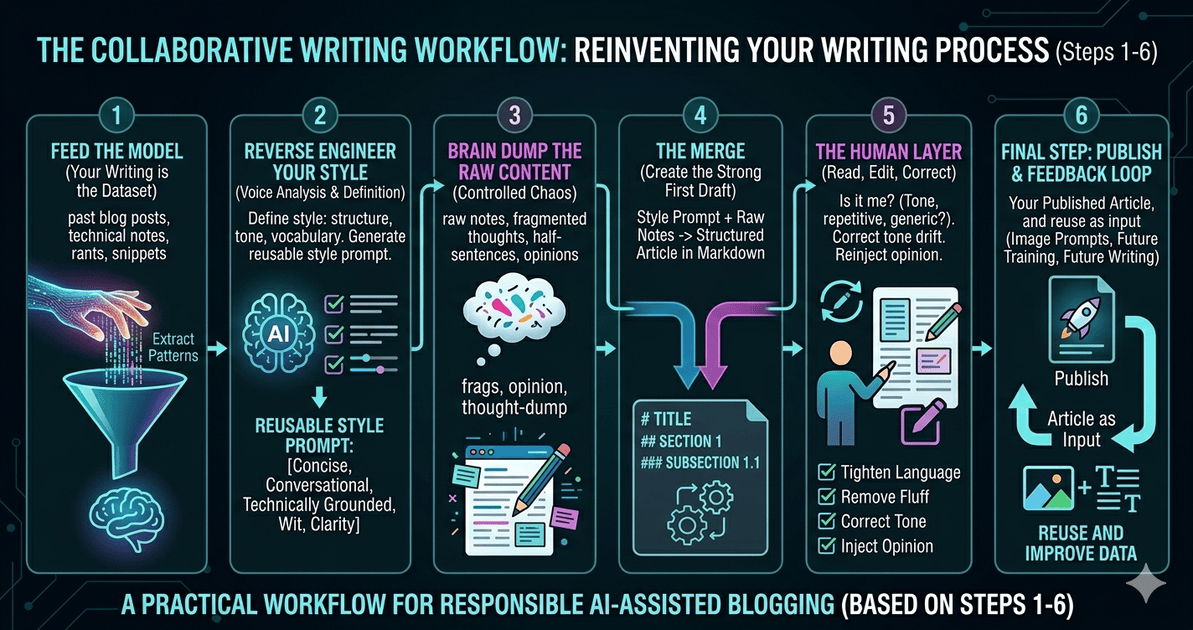
Writing with AI Without Losing Your Voice: A Practical Workflow for Responsible AI-Assisted Blogging
AI didn’t replace writing.
It replaced blank pages.
That distinction matters more than most people admit.
When used correctly, large language models aren’t ghostwriters—they’re accelerators. But like any accelerator, you still need a steering wheel, a map, and a healthy respect for what happens when you floor it without direction.
This is the workflow I use to keep AI useful, grounded, and—most importantly—aligned with my own voice when writing technical and semi-technical blog content for GitHub.
1. Feeding the Model: Your Writing is the Dataset
Most people start wrong here. They jump straight into prompts like:
“Write me a blog about X in my style.”
That’s not how style works.
Instead, I start by giving the model me.
That means:
- Past blog posts
- Technical notes
- Rants that accidentally turned insightful
- Half-finished drafts that still carry tone and structure
- Documentation snippets I’ve written over the years
The goal isn’t perfection. It’s pattern extraction.
Because AI doesn’t “understand your voice”—it statistically approximates it.
And the more consistent input you give it, the better the approximation becomes.
Think of it like this:
Garbage input = generic internet blog voice
Curated personal writing = something that actually sounds like you
2. Reverse Engineering Your Own Style (Yes, Let the AI Describe You)
Once I’ve given the model enough material, I ask it to do something deceptively powerful:
“Analyze this writing and define my style. Then produce a reusable prompt that reproduces it.”
This is where things get interesting.
The model will usually break down things like:
- Sentence structure (short, long, fragmented, formal, etc.)
- Tone (direct, sarcastic, instructional, reflective)
- Vocabulary density (technical vs conversational balance)
- How ideas transition (linear vs exploratory)
- How conclusions are handled (clean wrap-ups vs open-ended thinking)
Then I take it one step further:
I turn that analysis into a style prompt template. Keeping it forever, and fine-tuning on occassion depending on context.
That prompt becomes my reusable “voice injector.”
Instead of re-explaining myself every time, I now have something like:
“Write in a concise, technically grounded but conversational tone. Avoid fluff. Favor practical explanation over theory. Use controlled wit. Maintain clarity for mixed technical/non-technical readers…”
This becomes my baseline identity layer for the model.
Not magic—just structured consistency.
3. Dumping the Raw Brain (a.k.a. Controlled Chaos)
This is my favorite part.
Instead of trying to write a clean outline first, I just dump notes.
It usually looks like:
- fragmented thoughts
- half-sentences
- technical keywords
- opinions without structure
- “this might be useful later” ideas
- occasional existential commentary on systems or workflows
It’s not pretty.
It’s not supposed to be.
This step removes the pressure to be coherent too early.
Because coherence is easy for AI. Original thinking is not.
So I treat the model like a structuring engine, not a thinking replacement.
4. The Merge: Style Prompt + Raw Notes → First Draft
Now we combine two things:
- The style prompt (your voice definition)
- The raw notes dump
Then I instruct the LLM:
“Use my writing style definition. Convert these notes into a structured, blog-ready article in Markdown. Preserve intent, but improve clarity and flow.”
This is where the transformation happens:
- scattered thoughts become sections
- technical fragments become explanations
- repetitive ideas get condensed
- structure emerges without me forcing it
What I get back is not final content.
It’s a strong first draft with my fingerprints on it.
That distinction matters.
If the AI is doing it right, you should still recognize the ideas as yours—not something freshly invented by the model.
5. The Human Layer: Read, Edit, Read Again
This is the step most people skip—and it shows.
AI-generated writing is not “done,” even when it looks polished.
My review process is simple:
First pass:
Does this sound like me?
Second pass:
Is anything overstated, repetitive, or too generic?
Third pass:
Would I actually publish this as-is?
During editing, I focus on:
- tightening language
- removing unnecessary explanations
- re-injecting opinion where the model flattened it
- correcting tone drift (AI loves to become neutral when you weren’t)
This is where the writing becomes authored again instead of merely generated.
6. Publish… and Reuse the Output as Creative Fuel
Once finalized, the article isn’t just content—it becomes input for other systems.
In my workflow, I often take the final blog post and reuse it as:
- image generation prompts (for blog headers or visuals)
- future style training material
- reference context for new writing
- even documentation snippets for technical projects
It’s not a one-way pipeline.
It’s a loop.
Write → refine → publish → reuse → improve input data
That feedback loop is where AI actually becomes powerful for personal writing systems.
Final Thought: AI Doesn’t Replace Writers—It Amplifies Patterns
The biggest misconception about AI writing tools is that they “write for you.”
They don’t.
They extend what you consistently feed them.
If your input is shallow, your output will be generic.
If your input is structured, intentional, and reflective of your real voice, the model becomes surprisingly good at staying in character.
Not perfectly.
But consistently enough that the gap becomes an editing problem—not a writing problem.
And that’s where the real productivity gain lives.
Not in skipping writing.
I will continue to write articles 100% on my own to polish and hone my own style but.. definitely not always. Definitely not.