Managing Risk in Intelligent Transportation Systems (ITS): Borrowed Frameworks
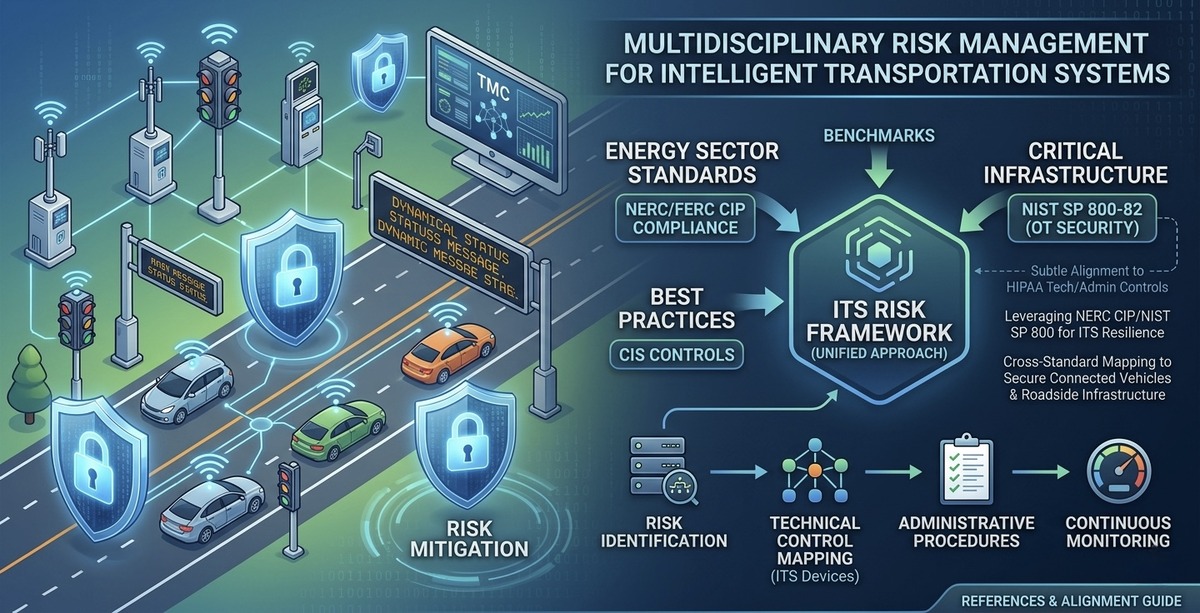
Managing Risk in Intelligent Transportation Systems (ITS): Borrowed Frameworks, Real Control
Intelligent Transportation Systems (ITS) live in a strange in-between world.
They’re not quite traditional IT.
They’re not fully industrial control systems (ICS).
And—importantly—they don’t yet have a universally adopted control framework of their own.
But risk still exists.
And risk still has to be managed.
So how does risk actually get managed in ITS environments today?
The short answer: by borrowing mature disciplines from adjacent regulated domains—OT, energy, healthcare, and enterprise security—and applying them pragmatically to traffic systems, field devices, and control networks.
The longer answer is what this article is about.
ITS Risk Reality (Before the Frameworks)
Most ITS environments share common traits:
- Long-lived field devices (10–20+ years)
- Safety-critical outcomes (human health and safety)
- Vendor-managed firmware and proprietary protocols
- Limited patch windows (or none at all)
- Flat or semi-flat networks by necessity
- Operational ownership outside traditional IT
Sound familiar?
It should—because this is classic operational technology (OT) risk, even if we don’t always call it that.
The OT Anchor: NIST SP 800-82 (Rev. 3)
When ITS practitioners want a technically defensible place to stand, they usually land here:
NIST Special Publication 800-82 Rev. 3 – Guide to Operational Technology (OT) Security.
This document does not care what your system controls; power, water, or traffic signals. It cares about how control systems behave.
Key OT principles that map cleanly to ITS:
1. Safety First, Availability Always
- Confidentiality is secondary
- Integrity and availability dominate risk decisions
- A failed signal cabinet is worse than leaked logs
2. Compensating Controls Over Patching
- Patch latency is expected
- Network segmentation, access control, and monitoring matter more than CVE velocity
3. Zones, Conduits, and Trust Boundaries
- Field devices ≠ Technical Management Center ≠ enterprise IT
- Logical separation matters even when physical separation is impossible
4. Vendor Dependency Is Assumed
- Risk management includes contract language, firmware lifecycle, and supportability
- “Vendor risk” is operational risk, not procurement trivia
In practice, many ITS programs quietly align their architectures to 800-82 concepts, even if they don’t formally declare it.
The Energy Sector Parallel: NERC / FERC CIP
If you want to see what happens when OT risk becomes regulated, look at the energy sector.
NERC CIP doesn’t define security best practices—it defines minimum enforceable behaviors.
The biggest lesson ITS borrows from CIP isn’t controls—it’s governance discipline:
- Asset classification matters
- Documentation is a control
- You don’t secure everything equally—and that’s okay
Even without regulation, many DOTs naturally drift toward CIP-like thinking when risk becomes operationally visible.
The Enterprise Control Spine: NIST CSF + 800-53
Where OT guidance ends, enterprise security fills in the gaps.
- Identity and access management
- Logging and auditability
- Change management
- Policy enforcement
- Third-party risk workflows
While 800-53 is often “too heavy” to apply directly, its control intent translates cleanly when scoped properly.
In ITS, the trick is control scaling:
- One strong access control at the Technical Management Center is better than 30 weak ones in the field
- One authoritative asset inventory beats 10 spreadsheets nobody trusts
The Quiet Similarity: HIPAA (Yes, Really)
Here’s where things get interesting.
While ITS has nothing to do with healthcare, the HIPAA Security Rule quietly mirrors how mature ITS programs already behave.
Administrative Safeguards
- Risk analysis
- Risk management
- Workforce access control
- Vendor accountability
Technical Safeguards
- Unique user identification
- Access controls
- Audit controls
- Transmission security
HIPAA never mandates how to implement controls—it mandates that you demonstrate intent, assessment, and follow-through.
That same model works remarkably well for ITS:
- Fewer prescriptive controls
- More documented decision-making
- Strong emphasis on “reasonable and appropriate”
In other words: process maturity over checkbox security.
The Control Rosetta Stone: CIS Critical Security Controls
If NIST defines what and CIP enforces how much, the CIS Critical Security Controls (v8) explain how to actually do the work.
Why CIS maps well to ITS:
- Asset inventory (IT and OT)
- Secure configuration baselines
- Controlled use of administrative privileges
- Network monitoring and defense
- Incident response fundamentals
CIS works because it’s operationally realistic—especially when adapted:
- Field devices grouped by class, not individually managed
- Monitoring at aggregation points, not endpoints
- Controls prioritized by blast radius, not perfection
So How Is ITS Risk Really Managed?
In practice, mature ITS risk programs:
- Classify systems by safety and operational impact
- Borrow OT architecture principles from NIST 800-82
- Adopt CIP-style governance discipline without regulatory weight
- Use enterprise frameworks for identity, logging, and process
- Treat vendors as long-term operational partners
- Document risk decisions as deliberately as technical ones
No single framework does this alone.
But together?
They form a defensible, auditable, and realistic risk posture—even in the absence of ITS-specific controls.
The Future: ITS-Specific Controls (Eventually)
ITS will likely get its own control framework someday. In fact, I Regularly meet with the people behind the scenes and work with them to do so.
Until then, the strongest programs won’t wait.
They’ll continue doing what works:
- Multidisciplinary risk management
- OT-aware engineering
- Enterprise-grade governance
- Safety-first security decisions
And when ITS-specific controls do arrive?
The organizations already operating this way won’t have much to change at all.
References
- NIST SP 800-82 Rev. 3 – Guide to Operational Technology (OT) Security
- NIST SP 800-53 Rev. 5 – Security and Privacy Controls
- NIST Cybersecurity Framework (CSF) 2.0
- NERC CIP Reliability Standards
- HIPAA Security Rule (45 CFR Part 164)
- CIS Critical Security Controls v8