Why I Left AWS
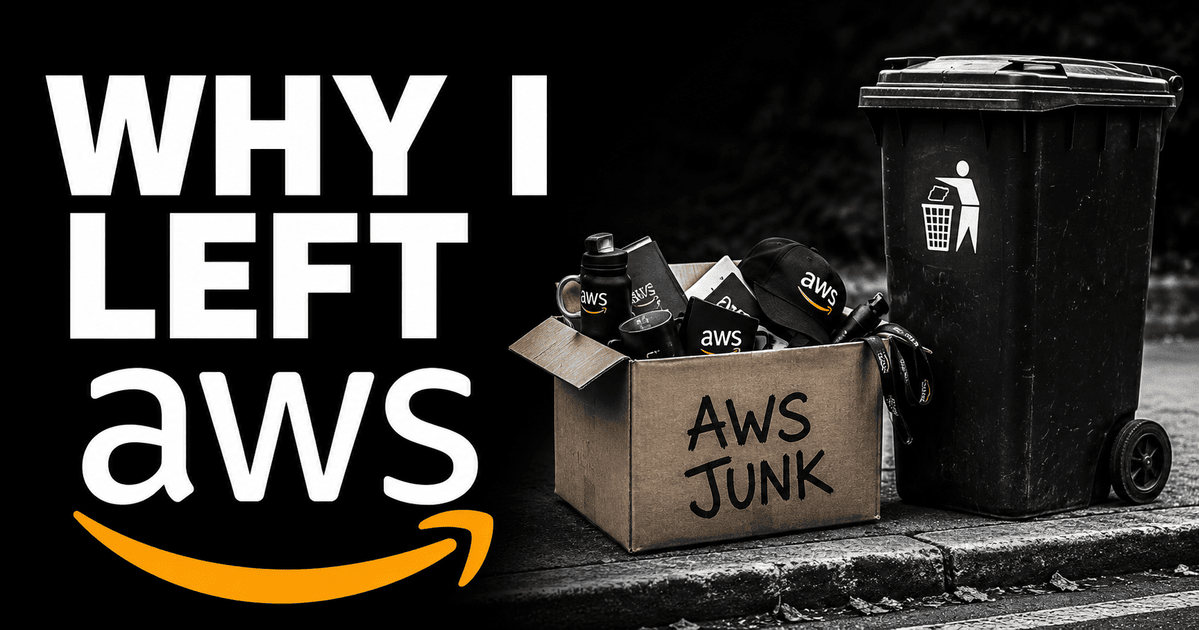
Why I Left AWS - (A Complete Explanation For A Complicated Choice)
I get asked about this a lot.
More than feels proportional.
I get it. AWS is a FAANG. The pay. The humble bragging rights. The work it took to get to that point in my career. The stock options.
But…
Despite spending years in other industries and roles, people keep circling back to why I left AWS—a comparatively short chapter in my career.
Lately, I’ve realized the fatigue doesn’t come from the question itself.
It comes from the fact that the answer can’t be reduced to a 1 minute summary. Answering it feels like the ramblings of a madman.
There was no single catalyst.
No dramatic fallout.
No villain-of-the-week. Almost all of my customer ratings were 4-5 stars (out of five) and I had completed every piece of training I was handed and so much more. I lived in A Cloud Guru. I earned certifications and the trust of senior engineers.
But… I left. I made a choice.
It was a layered, compounding unfortunate experience that started early and quietly got worse.
This is the clearest version I can give—once—so I can stop rambling through it every time.
The Problems Started Almost Immediately
1. Onboarding, Mentorship, and Leadership (Before Anything Else)
Before culture, before layoffs, before return-to-office—there was onboarding.
And it was rough.
My onboarding and mentoring experience was deeply inconsistent:
- Difficulty getting time with my assigned mentor
- Little structured guidance
- Constant friction getting answers I genuinely needed
What made it worse was watching peers have excellent mentors:
- Regular touchpoints
- Advocacy
- Clear guidance
Those peers succeeded faster. That wasn’t subjective—it was obvious.
Mentorship mattered. I didn’t have it.
This early instability set the tone. I never felt fully grounded, and that’s not something you can easily recover from in a high-pressure environment.
So what did I do to address this?
- Frequently made mention of my concerns to management
- Attempted multiple pathways to communicate with OB and Mentor
- Escalated to higher leadership
2. The Role I Didn’t Want (But Got Anyway)
When I was hired, I was offered three potential role paths.
I was placed into:
- My last choice
- The least aligned with my long-term goals
- The furthest from hands-on cybersecurity work
I tried to make it work. But starting misaligned—while lacking strong mentorship—made progress feel uphill from day one.
I never gave up on my work, however, I knew there were countless opportunities and if I had to make my way through the mailroom - that worked just fine for me but it would play an important part when…
Then the Company I Joined Started Disappearing
3. “We’re Proudly Remote”… Until We Weren’t
I was hired fully remote into a company that loudly celebrated being remote-first.
Shortly after:
- Spending was frozen
- Travel budgets vanished
- Annual company gatherings were canceled
- Return to office rumors
I never attended a single in-person AWS event. I never met a single person face to face. That chapter in my life feels like a fever dream. Did it really happen?
Culture doesn’t survive on internal tools alone.
That early pullback killed morale before it ever had a chance to grow.
4. Hiring Freezes and the Slow Stall
Then came the hiring freezes.
Not temporary pauses—momentum killers:
- Teams stretched thin
- Work redistributed
- Growth quietly deprioritized
When hiring eventually resumed, it wasn’t the same environment anymore.
Because…
5. Return to Office (And the End of Mobility)
I was based in Colorado.
My “home office” was Portland.
There was no nearby office.
Once return-to-office became real:
- Remote promotion paths vanished
- Lateral movement dried up
- “Be remote and advance” stopped being an option
The ladder didn’t get steeper.
It got removed.
This amplified the dread of the daily grind and the feeling that…
The Culture Shift Wasn’t Subtle
6. Metrics Over Humanity
AWS runs on metrics. Aggressively defined metrics. Metrics are fine.
Metric absolutism is not.
It felt like:
- If you weren’t a metric superstar, you weren’t allowed to be human
- Personal lives were tolerated only for senior, established high performers
- Everyone else was expected to stay quiet and produce
Efficient? Yes.
Human? No.
But I still have my work, and I can learn so much, there was stability until…
7. Layoffs—Public, Massive, and Constant
In my short time there:
- Three public layoffs
- Each one larger than the last
- Each one involving thousands of people
Every workday carried background noise:
Is today the day?
Frequently checking public government sites for layoff announcements that usually hit before the 1:1.
That kind of stress doesn’t spike—it erodes.
That couldn’t possibly trigger human response to defend their own resources, right? It couldn’t possibly lead to…
8. Tribalism and Isolation After RTO
Once return-to-office was fully committed:
- Local-office staff clustered together
- Senior engineers protected their circles
- Escalations became harder
- Collaboration became political
If you weren’t physically present, you felt it.
Isolation doesn’t need hostility to work.
BUT I still had my work and that work - what’s the worst that could happen? I can deal with all of this. Until I discovered the final problem…
The Breaking Point Was Meaning
9. I Didn’t Believe in What the Work Was For
This part took longer to admit—to myself.
I struggled with the idea that my work ultimately existed to:
- Generate revenue
- Optimize profit
- Make already enormous systems even more money
I searched for something—anything—that felt like a greater good.
I came up empty.
One moment crystallized it: I was once yelled at by an engineer whose company sold online content - which in no way would be considered beneficial to society..
That’s not a metaphor.
That’s not a joke.
It’s an awful feeling to realize:
This is what my stress is serving.
So…
Why I Left—and Where I Went Instead
10. Choosing Cybersecurity (Again) — For the Right Reasons
That clarity pushed me to make a decision.
I wanted back into a pure cybersecurity role:
- Where people actually wanted my opinion
- Where judgment mattered more than dashboards
- Where the work protected people, systems, and public trust
I wanted to contribute to something that felt constructive, not extractive.
I wanted purpose.
And I wanted my family back at the dinner table.
By the time the layoff finally came, I had already mentally left months earlier.
The Short Version
I didn’t leave because AWS is “bad.”
I left because:
- The company I joined no longer existed
- Support systems failed early
- Growth paths closed
- Culture shifted toward metrics and fear
- The work lost meaning
- And my family paid the price
Final Thought
AWS was a chapter—not the book.
I learned things I couldn’t have learned elsewhere.
I met brilliant people.
I gained perspective that still shapes how I work.
But staying would have required becoming someone I didn’t recognize.
And that’s not a trade I’m willing to make.
If you’re still curious after this—feel free to ask.
This is the version I’ll be pointing to from now on.