Risk Management Lifecycle in Intelligent Transportation Systems
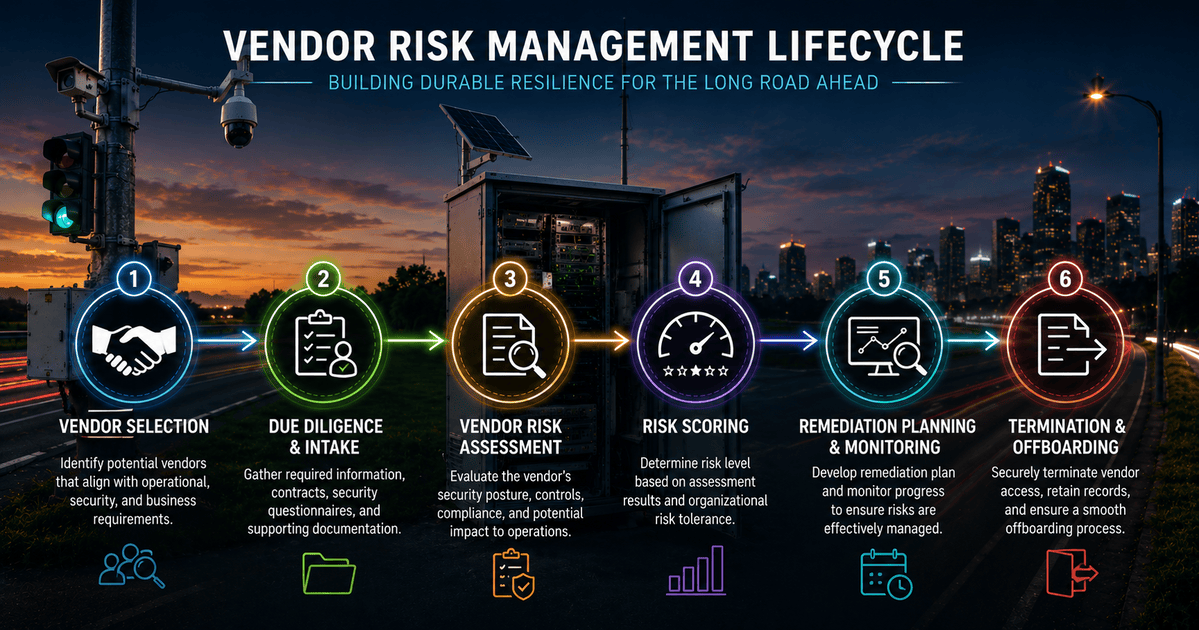
When Risk Has a 15-Year Service Life
In traditional IT, “end of life” often means next quarter.
In Intelligent Transportation Systems (ITS), end of life means after the asphalt gives up first.
Roadside devices don’t live in climate-controlled data centers. They live on poles, in cabinets, under bridges, and in environments where funding cycles are short, hardware lifespans are long, and replacement is rare. That reality fundamentally changes how risk management must work.
The risk management lifecycle in ITS isn’t about chasing perfection.
It’s about building something durable, visible, and survivable—even when vendors, products, and contracts disappear.
The ITS Risk Management Lifecycle (Reality Edition)
Most risk frameworks look clean on paper. ITS risk management does not.
Here’s how the lifecycle actually plays out when devices are expected to remain roadside for a decade or more.
1. Identify Risk (With Longevity in Mind)
Risk identification in ITS starts with the obvious:
- Legacy operating systems
- Embedded firmware
- Limited patch windows
- Physical exposure
But the real question is this:
Will this risk still be manageable when the vendor no longer exists or the product is no longer supported?
If mitigation depends entirely on a manufacturer portal, subscription, or cloud service, that risk has an expiration date—and it’s usually shorter than the device’s deployment life.
2. Analyze Risk (Funding Is a Threat Actor)
In government environments, funding constraints are not hypothetical. They are predictable.
Risk analysis must assume:
- Delayed refresh cycles
- Deferred upgrades
- Staggered deployments across years
- Mixed firmware and hardware generations
This shifts analysis away from “best possible control” toward best sustainable control.
A compensating control that can be operated internally for 15 years is often lower risk than a perfect vendor provided control that expires in year three.
3. Treat Risk (Compensating Controls Win Over Time)
This is where ITS diverges from enterprise IT.
Vendor-managed security controls:
- Require renewals
- Depend on continued product support
- Assume stable budgets
- Assume vendor longevity
Internal compensating controls:
- Are visible
- Are auditable
- Can be trained, documented, and transferred
- Survive procurement changes
In long-lived roadside environments, network segmentation, traffic monitoring, access restrictions, and logging consistently outlast vendor promises.
The less a mitigation depends on an external roadmap, the longer it remains effective.
4. Monitor Risk (Because Nothing Stays Static)
ITS environments change slowly—but they do change:
- Network paths evolve
- Central systems are modernized
- Threats adapt to exposed infrastructure
Continuous monitoring doesn’t mean bleeding-edge tools. It means:
- Consistent telemetry
- Clear ownership
- Alerts people understand
- Logs someone actually reviews
If monitoring can’t be maintained during staff turnover, budget cuts, or reorganization, it’s not durable enough.
5. Review and Adjust (Without Replacing the Device)
Risk reviews in ITS are rarely followed by immediate remediation.
They’re followed by prioritization.
The lifecycle must allow for:
- Deferred treatment
- Layered mitigation
- Incremental improvement
The goal is not to “close findings.”
The goal is to prevent risk from growing silently over the lifespan of the asset.
Why Internal Controls Age Better Than Vendor Controls
Vendors build products for market cycles.
Government builds infrastructure for decades.
That mismatch matters.
Internal compensating controls:
- Don’t get end-of-lifed
- Don’t require license renewals
- Don’t disappear after acquisitions
- Don’t assume always-on connectivity
This aligns naturally with established risk management framework’s guidance—but with a practical, infrastructure-first interpretation rather than a cloud-first one.
Designing Risk for the Long Road Ahead
Effective ITS risk management accepts uncomfortable truths:
- Some devices will never be patched
- Some vendors will vanish
- Some risks will be accepted—intentionally
Durability comes from visibility, ownership, and control.
If a mitigation can be explained to a new engineer ten years from now—and still works—it belongs in the lifecycle.
Everything else is temporary.
In ITS, risk management isn’t about keeping up.
It’s about holding steady—long after the purchase order is forgotten.